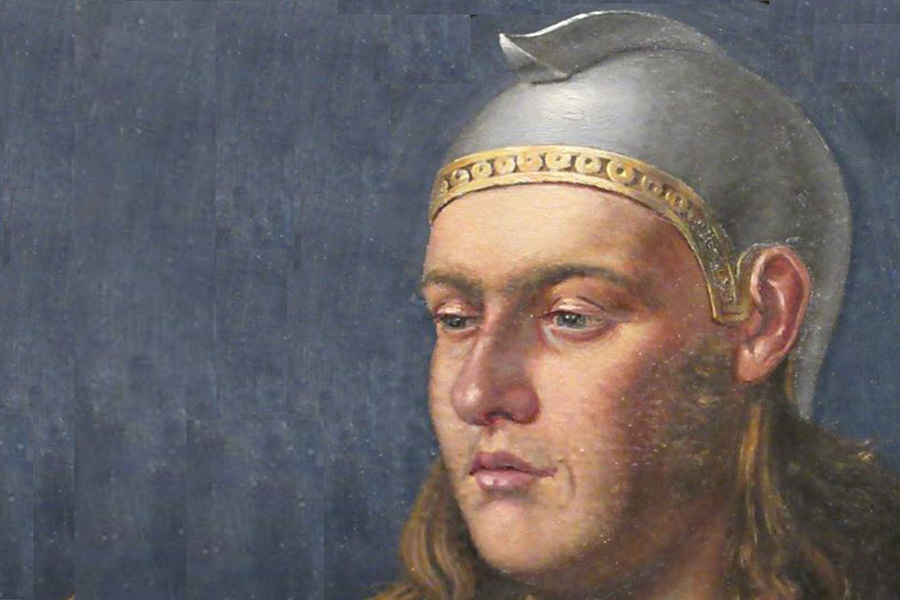
Basic Information
| Field | Data |
|---|---|
| Name | Harthacnut I of Denmark (also Hardeknud, Cnut I) |
| Period | Early 10th century (circa 900–945, traditionally) |
| Status | Semi legendary; appears in Old Norse sagas and later chronicles |
| Probable domains | Zealand, Scania, Halland and parts of Jutland according to saga tradition |
| Religion | Norse paganism in narrative sources |
| Principal descendant | Gorm the Old (son) |
| Notable identification | Possibly identical with the Hardegon mentioned by Adam of Bremen |
| Numismatic hint | English coin inscription Airdeconut possibly linked to his name |
Biography and the Shape of a Legend
Harthacnut arrives in the record not as a cleanly dated monarch but as a silhouette sketched by saga, chronicle, and the occasional coin. Old Norse tradition, especially the tale-cycle that ties him to Ragnar Lodbrok through Sigurd Snake-in-the-Eye, paints him as a son of legendary lineage and a king of the Danish islands and southern provinces. That portrait is vivid but porous; the contours are drawn from oral memory as much as from contemporary record, and absolute chronological certainty remains elusive.
Medieval chroniclers complicate the picture in practical ways. A German cleric writing in the 11th century, Adam of Bremen, records a conquest of Denmark early in the 10th century by a figure called Hardegon, described as son of someone named Sweyn. Some historians read Hardegon as the same man whom Norse memory called Harthacnut, while others see separate traditions converging on similar names and deeds. The effect is like overlapping maps of the same coastline drawn at different times; shorelines match, but tidal detail varies.
Family, Bloodlines, and Dynastic Claims
The most persistent claim attached to Harthacnut is dynastic. Saga genealogy makes him the son of Sigurd Snake-in-the-Eye, who in turn is a son of the semi mythic Ragnar Lodbrok. In that pedigree Harthacnut becomes the vital link to historically attested kings: he is the father of Gorm the Old, and through Gorm the dynasty proceeds to Harald Bluetooth and then to the line that produced Sweyn Forkbeard and Cnut the Great. The line reads like one of those braided cords in which legend and lineage twist together until it is hard to see which strand is which.
Below is a concise family table that captures the principal relationships credited to Harthacnut in saga and later tradition.
| Family Member | Relation | Role in tradition |
|---|---|---|
| Sigurd Snake-in-the-Eye | Father | Legendary son of Ragnar; establishes the Ragnarid link |
| Blaeja | Mother | Said to be daughter of Ælla of Northumbria in saga accounts |
| Gorm the Old | Son | First historically attested king in the dynasty |
| Harald Bluetooth | Grandson | Unifier and Christianizer of Denmark in later history |
| Sweyn Forkbeard | Great grandson | Future king of Denmark and England in the 11th century |
Rule, Conquest, and a Reign in Fragments
Narrative sources and later chroniclers picture Harthacnut as a consolidator of fragmented Danish rulership in the early 900s. Some accounts assign him a reign of a few decades in which he ousted Swedish backed rulers like Sigtrygg Gnupasson and established a stable base in southern Denmark. That stability, if historical, would have provided the soil in which the Jelling dynasty could take root. Yet the archaeological record and contemporaneous foreign accounts do not yield a tidy reign length or sequence, so historians bracket him as probable rather than proven.
Financial detail does not survive; Viking rulers accrued wealth through a mix of raiding, tribute, control of trade routes, and local resource extraction. Harthacnut’s imagined wealth is inferred from his supposed capacity to hold territory and found a dynasty rather than from direct inventories.
Coin, Hoard, and a Name in Metal
A striking piece of material evidence that feeds modern debate is a coin discovered in the Silverdale hoard bearing the name Airdeconut. Numismatists and museum scholars suggest that Airdeconut may be an Anglo Saxon attempt at the Norse name Harthacnut. The coin’s existence shows how names and rulers moved between Scandinavia and northern England, and it supplies a rare hard tile to set under the softer sagas. Like finding a footprint in stone that matches a story told in smoke, the coin hints at cross sea activity and a ruler whose name could be pronounced differently in different tongues.
Timeline at a Glance
| Approximate date | Event |
|---|---|
| c. 873–890 | Probable birth window in saga tradition |
| c. 900–917 | Period associated with conquests attributed to Hardegon/Harthacnut |
| c. 915–917 | Deposition of Sigtrygg Gnupasson in some chronicle narratives |
| c. 917–945 | Traditional span for Harthacnut style rule in later accounts |
| c. 936–958 | Reign of son Gorm the Old; Jelling monuments appear soon after |
Numbers in these boxes are scaffolding rather than carved stone; they provide a framework for a past where exact years often refuse to be nailed down.
Myth, Memory, and the Historian’s Gauge
Harthacnut moves along the border between myth and history. Saga literature supplies names, motifs, and family links that enhance prestige and legitimize later rulers. Continental chronicles add an outsider’s perspective that sometimes aligns and sometimes contradicts Norse memory. Modern scholarship treats Harthacnut as a probable historical figure who became larger in the retelling, like a small hearth fire that is described in the next village as a bonfire. The result is a figure who is crucial to Denmark’s royal origin story and yet remains, in many specific claims, provisional.
FAQ
Who was Harthacnut I?
Harthacnut I is a semi legendary early 10th century figure who appears in Old Norse sagas as a king and as the father of Gorm the Old.
Was Harthacnut a real king of Denmark?
He is treated as probable by many historians, but the evidence mixes saga tradition and later chronicles so certainty is limited.
Is Harthacnut linked to Ragnar Lodbrok?
Saga genealogies make Harthacnut a descendant of Ragnar through Sigurd Snake-in-the-Eye, but that lineage blends myth and memory.
What is the Airdeconut coin and why does it matter?
A coin inscribed Airdeconut from the Silverdale hoard may reflect an Anglo Saxon rendering of Harthacnut and shows cross sea influence.
Who succeeded Harthacnut?
Gorm the Old is traditionally counted as his son and successor and is the first clearly historical king in the line.
Why do sources disagree about his deeds?
Different cultural vantage points and the passage of oral tradition produce divergent names and sequences, creating conflicting accounts.